Indoor air quality
We spend about 90 percent of our time indoors, so what's moving through that duct matters.
Whole-home air cleaners, upgraded filtration, humidifiers, dehumidifiers, purifiers and real ventilation, all fitted to the HVAC system already in your attic, not sold as a separate box.
Humidity is a second load your thermostat can't see
A house can read seventy four degrees on the wall and still feel wrong, sticky, heavy, not quite comfortable, and the reason is almost always relative humidity sitting somewhere north of sixty percent while the thermostat only ever reports temperature. If you live in Houston, you already know it's humid. Gulf proximity keeps outdoor moisture high for most of the year, and an air conditioner that's only sized to the square footage of the house, not the moisture load it's actually carrying, ends up fighting a battle the temperature number never shows you. Oversizing makes this worse, not better. A unit that's too big for the space cools the air fast, hits the setpoint, and shuts off again before it's run long enough to actually pull moisture out of it. That short-cycling is why an oversized system can leave a house cold and clammy at the same time. Sizing the equipment right in the first place, and adding a dedicated whole-home dehumidifier where the AC alone can't keep up, is what actually fixes it, not a colder setpoint.
What a filter change is really deciding
The one inch filter behind your return grille is doing real work, but it's a compromise built around what your duct was sized to breathe through, not around how much it could theoretically trap. A whole-house air cleaner replaces that one inch slot with proper media, filtration built to catch pollen, mold spores, mildew, bacteria and dust mites rather than just the visible dust a cheap filter stops. We describe our own filtration as capable of removing up to 99 percent of allergens, which is a figure worth stating as a manufacturer claim rather than a promise, because the honest caveat matters more than the number: a denser filter also adds resistance, and duct that was never sized for that resistance can lose airflow it needs elsewhere in the house. That's why filtration gets matched to the system, not bolted on and hoped for. Humidifiers split into two real designs, bypass units that use the furnace's own airflow to carry moisture into the duct, and steam units that generate it directly and don't depend on the blower running. Ventilation is the other half most people miss. Ventilation is the V in HVAC, and it means deliberate, filtered air exchange with outside, not just whatever leaks in around a window frame. UV treatment inside the system is best understood as a coil-cleanliness measure, keeping the evaporator coil from growing a biofilm in the dark and the damp, rather than a cure for anything already circulating in the room.
Champion and Nash, TACLB123086E, NATE and ACCA certified. Call (713) 360-0564.
Where a central system stops and a mini-split picks up
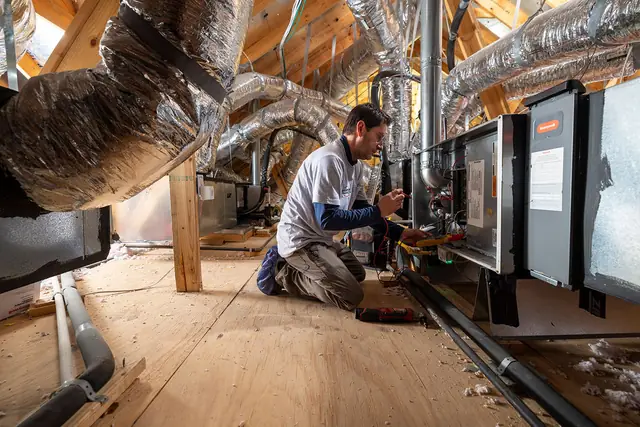
Air quality work usually happens at the equipment your central system already has, the air handler, the return, the duct run into the attic. But not every room is actually reached by that system in the first place. A converted garage, a room built out over the porch, an office nobody ever ran duct to, those spaces don't have a filtration or humidity problem so much as an air problem, full stop, because conditioned air from the main system barely gets there to begin with. That's a job for a ductless mini-split rather than another filter upgrade. On the equipment side, everything above, filter grade, humidifier choice, ventilation strategy, gets sized against the same load calculations we use on a full air conditioning install, because indoor air quality only works when it's designed around the system actually moving the air, not added on top of it as an afterthought.
What we're actually asking
Is the humidity load separate from the temperature problem. Is the existing filter slot fighting the duct it sits in. Is the house getting real ventilation or just whatever leaks in around the doors and windows. Answering those three, in your attic, on your system, is the whole visit.
Same roster, same 24 hour line. Talk to us about what your house is actually doing at the contact page.