Heat Pumps
One Unit, Built for Houston's Short Winters
Heat pump installation, repair and maintenance from a Spring, TX crew that works the same unit in both directions, all year round.
What Brennan checks on a heat pump call
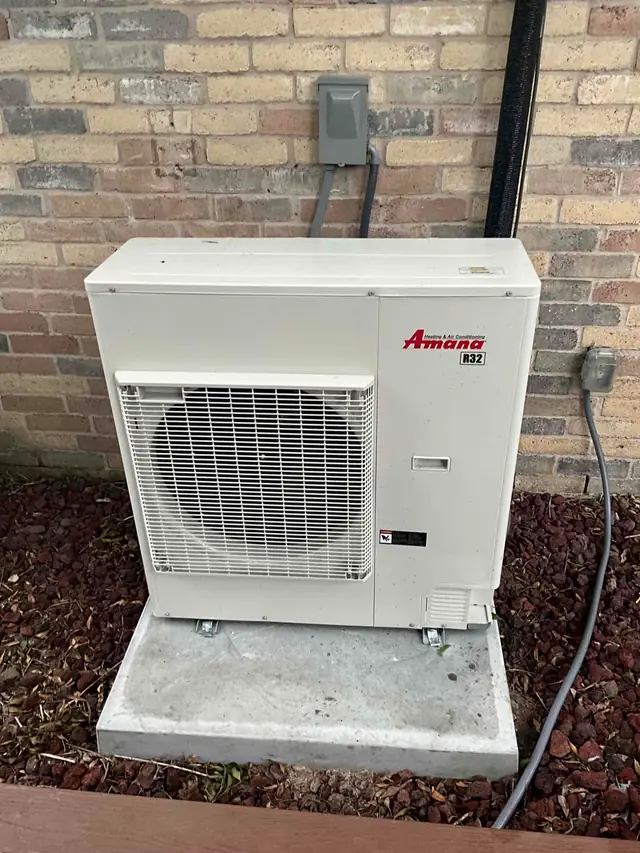
A heat pump is one outdoor unit doing the job of a furnace and an air conditioner, because it runs the same refrigerant loop in two directions. A reversing valve flips the cycle. In summer the unit pulls heat out of the house the same way a straight AC condenser does. In winter it pulls heat out of the outside air, even cool air, and pumps it indoors. That is why one machine can replace two, and it is also why a heat pump makes more sense here than it does somewhere with a real winter. Houston's cold season is short. January is the coldest month, and the cold snaps that matter are the exception, not the rule, so a heat pump spends most of its winter pulling heat out of fifty and sixty degree air, which it does efficiently. The same unit that gets a house through a June afternoon in the 90s is doing real work on a cool January morning, just running the loop the other way. Brennan, who works heat pump and air conditioning calls out of the Spring base, checks the same unit whichever direction it is running, because underneath it is the same machine doing two jobs.
Defrost, aux heat and reading the charge right
On one of the rare near freezing Houston nights, ice can build on the outdoor coil, so the unit runs a defrost cycle to clear it. It briefly reverses back to cooling mode, sends warm refrigerant through the outdoor coil to melt the frost, and steam or vapor can rise off the unit for a minute or two. That is the system doing its job, not failing. If a heat pump is leaning on its auxiliary or emergency heat strips for more than the odd cold snap, something upstream is off, whether that is a low charge, an undersized outdoor unit, or a reversing valve that is not fully seating, because aux heat is resistance heat and it is meant to be a backup, not the default setting. A heat pump also runs far more hours a year than a furnace, since it is doing cooling duty all summer and heating duty all winter on the same compressor, so the maintenance interval that suits a furnace left idle for eight months is not the right interval here. Newer systems run R32 refrigerant, and R32 charge has to be measured with gauges against the manufacturer's chart, not guessed, because a heat pump running a half pound light will still blow air. It just will not blow enough of it to earn its keep in August.
Champion & Nash, TACLB123086E (HVAC) and M43146 (plumbing). NATE and ACCA certified. Call (713) 360-0564.
Sized to the house, not the invoice
Getting a heat pump quote right comes down to sizing. A unit that is too big for the house short cycles, never runs long enough to pull humidity out of the air, and the house ends up cool but clammy. A unit that is too small runs constantly and still cannot keep up on the hottest days. Getting that number right means a load calculation on the actual house, not a straight swap of the old tonnage for a bigger box because bigger sounds safer. It is the same read whether the job is heat pump installation, heat pump repair, or the seasonal heat pump maintenance that catches a low charge before it turns into a July no cool call.
If a heat pump is not the right fit for every room, say a converted garage or an office added on later, our ductless mini-split systems solve that without touching the existing ducted system. A heat pump call often turns up something worth a second look in the ductwork or the air itself, so ask whichever technician is at the door about air conditioning and indoor air quality work while they are there. See the full list on Services, or get in touch to talk through what is on the unit right now.