Commercial HVAC
A building that can't close for the afternoon needs a different kind of visit.
Over forty years of combined experience means we've learned commercial plant on real roofs, not in a classroom. Design, install, repair and maintenance for the equipment a business runs on, staged around the hours the building actually keeps.
The job changes once the building can't close
A house call and a commercial call start from the same technician and the same van, but the job itself is different from the first minute. Nobody is turning off the lobby air handler at two in the afternoon because a part is on order, so the work gets staged: parts and labour lined up before the unit comes offline, the swap done in the smallest window that closes it, or pushed to a night or weekend when the tenants and the traffic have both gone home. A rooftop package unit change-out is its own trade inside the trade. It isn't carried up a ladder. It comes in on a crane, on slings, guided down onto curb rails by two people reading each other's hands over the wind noise, and the access plan for that crane, the parking it needs, the permit for the lift itself, gets worked out before the truck ever shows up. Ductwork on a commercial job is designed, not inherited. A house usually keeps the duct run the last owner left it; a commercial retrofit gets laid out against the actual floor plan, the return paths sized for the square footage that's really there instead of guessed at from the unit it's replacing.
Life-cycle cost is the number, not the invoice
On a house, most owners are comparing one repair quote to one install quote. On commercial plant, the number that actually matters is what the equipment costs to run and to keep running across the years it's in service, not what it costs to hang. A cheaper unit with a worse SEER rating and a shorter service life can lose that math inside three summers of a Houston roof. We size and spec around that longer number, not the invoice total. Redundancy matters more too. A hospital corridor, a server room, a walk-in cooler full of stock doesn't get to just wait for the part. That's where portable or temporary cooling earns its place, keeping a space in service while the permanent equipment is down for a real repair rather than a patch. And because commercial equipment fails at 3am the same as it does at 3pm, the 24 hour line that answers a residential emergency answers a commercial one too, dispatched to whichever of our own technicians is already closest.
Champion and Nash, TACLB123086E, NATE and ACCA certified. Call (713) 360-0564, day or night.
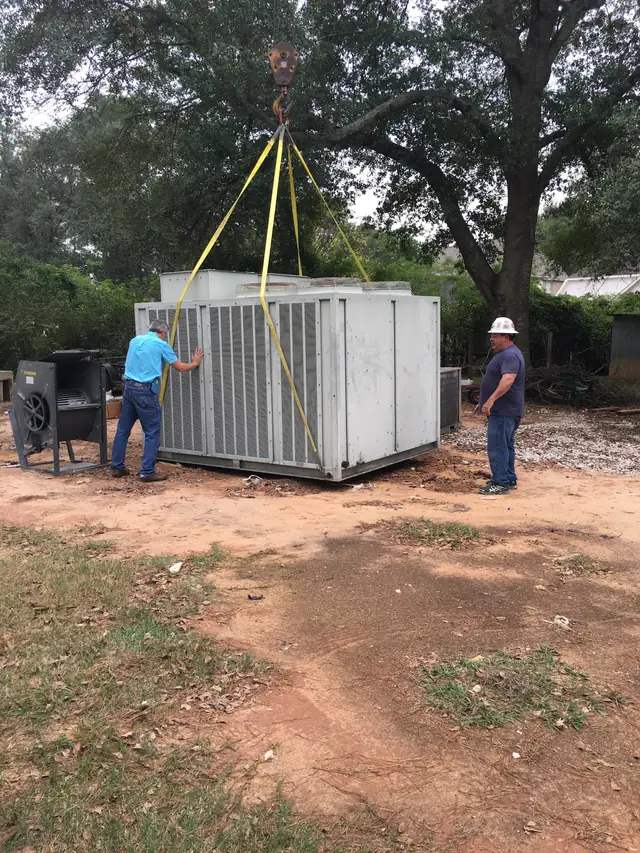
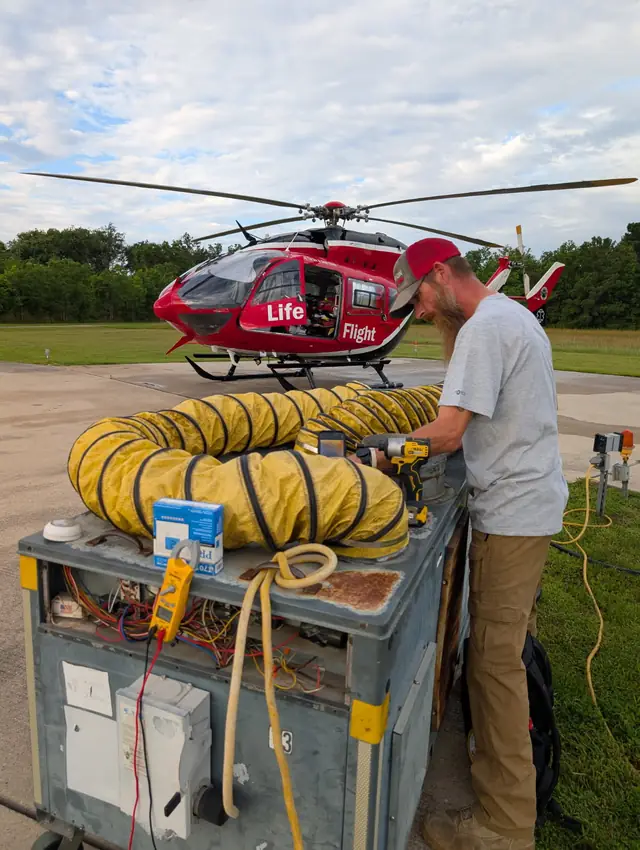
Portable cooling, ducted onto a hospital helipad. Not every commercial job is a rooftop swap. Some of it is a critical space that can never lose conditioned air, even for the hour it takes to fix what's actually wrong.
Keeping a critical space running while the real fix happens
A helipad, an operating suite, a data closet, a walk-in freezer full of inventory: none of them get to wait for a Tuesday parts delivery. When permanent equipment has to come offline for a genuine repair, portable or temporary cooling gets ducted in first so the space stays in service the whole time the real work is happening. It's the same discipline as the rooftop crane job on the same page, just running in the opposite direction: instead of installing new plant, it's keeping a critical function alive around old plant that's actively being fixed.
That's the difference commercial experience makes. A technician who has only ever worked residential systems doesn't think to ask what the space does while the unit is down. Micah, Zach, Bladen and the rest of the roster who answer the full service list have both kinds of calls behind them, which is why the question gets asked before the first tool comes out. If your building runs air conditioning and heating side by side with filtration or humidity control on the same system, or if a tenant space needs its own zone through a ductless mini-split, the same crew that hangs the rooftop unit designs that layout too.
Emergency service on commercial plant runs on the same 24 hour line as a residential call. Talk to us about your building at the contact page or see how a residential visit compares on the air conditioning page.